ICBS 2026: Five Priorities for Indonesia’s Carbon & Biodiversity Market
ICBA · 1 Oct 2026
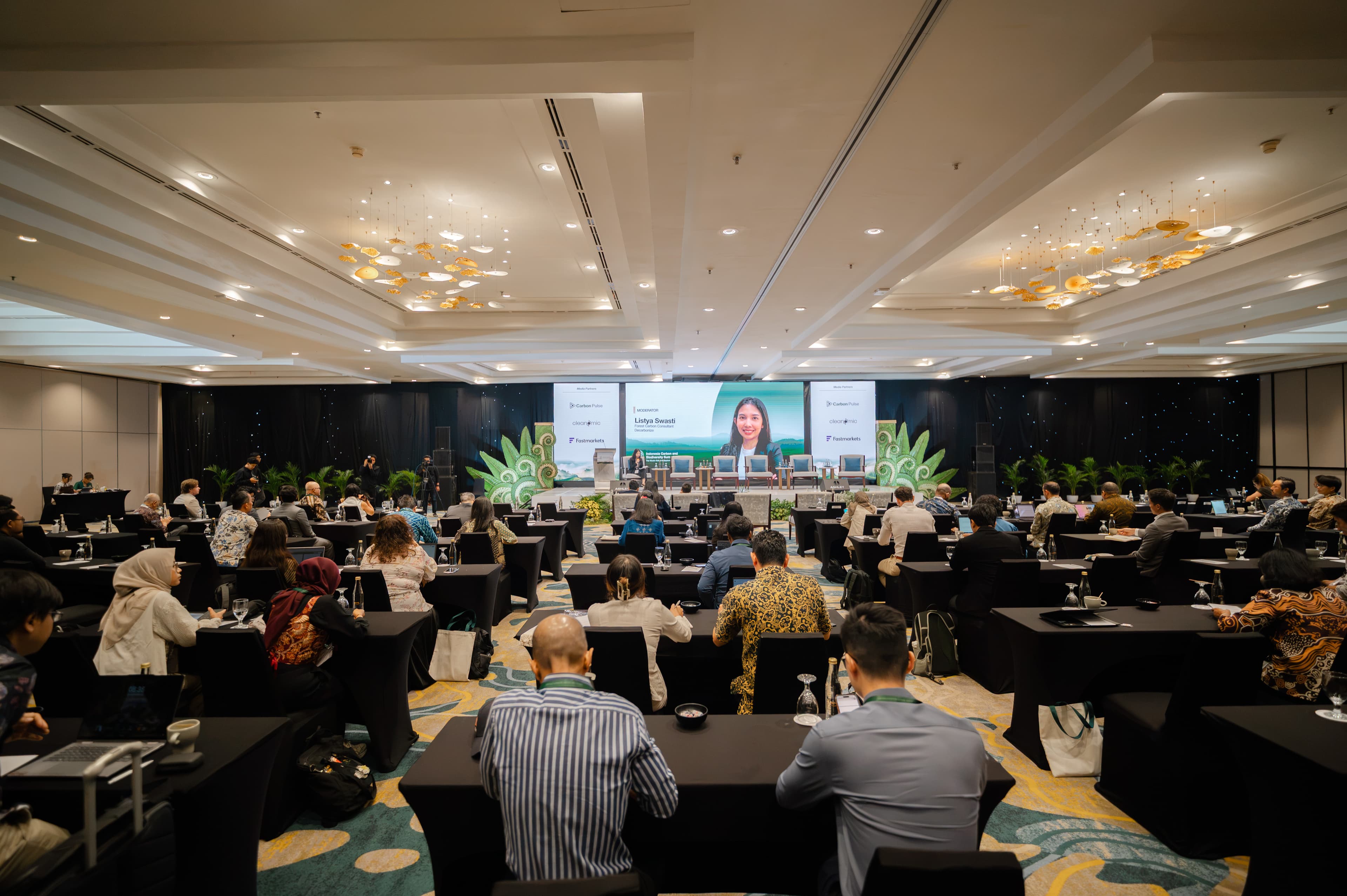
What the Indonesia Carbon & Biodiversity Summit revealed about the next phase of market development for Indonesia.
The Indonesia Carbon & Biodiversity Summit 2026 brought together project developers, carbon buyers, financiers, government representatives, standards bodies, market infrastructure providers, technical specialists and nature-sector leaders in Bali on 8–9 September.
Across two days of discussion, a clear picture began to emerge.
Indonesia does not lack carbon potential. Nor does it lack international interest, technical capability or projects capable of generating meaningful climate and biodiversity outcomes.
The more immediate challenge is turning that potential into a market that can operate with sufficient clarity, integrity and commercial confidence to scale.
The discussions at ICBS reflected a market moving beyond the question of whether Indonesia should participate more deeply in international carbon and nature markets. Attention is increasingly shifting towards how that participation should work in practice: how projects move from development to issuance, how international demand can be accessed, how integrity is demonstrated, how capital enters earlier, and how carbon finance can support wider outcomes for forests, biodiversity and communities.
Five priorities stood out. They are not formal resolutions of the Summit, nor do they represent complete agreement across every participant. They are the recurring issues that appeared across multiple discussions and which, taken together, point towards the work required during the next phase of Indonesia’s carbon and biodiversity market development.
1. Turn regulatory progress into practical market clarity
Indonesia’s carbon market has changed significantly in a relatively short period. The regulatory framework is becoming more defined, government institutions are engaging more actively with carbon markets, and pathways for domestic and international participation are developing. But for those building, financing and purchasing from projects, the central question is increasingly practical:
What does the pathway from project development to transaction actually look like?
Projects need to understand the approvals required at different stages, the relationship between national systems and international standards, the routes available for domestic and international transactions, and the conditions attached to the use or transfer of credits.
Buyers and investors need similar clarity. Regulatory uncertainty influences investment decisions, contract structures, pricing, timelines and the willingness of counterparties to commit capital before a project reaches issuance.
One point repeatedly reinforced at ICBS was that greater clarity does not require every future policy question to be settled before the market can move. Carbon markets everywhere continue to evolve. What matters is creating sufficiently predictable processes for credible projects and counterparties to make decisions.
That means continuing to translate regulation into practical implementation: clearer approval processes, understandable institutional responsibilities, workable market routes and greater visibility over how Indonesian projects can interact with international standards and demand.
The priority now
Indonesia must continue balancing national oversight, climate commitments, environmental and social integrity, and access to international capital and demand.
The next phase will depend less on broad policy direction and more on how these objectives are reconciled in practice.
2. Make integrity measurable, understandable and commercially relevant
“High integrity” has become one of the most frequently used terms in global carbon markets. But integrity only becomes meaningful when it can be demonstrated.
One of the strongest themes from ICBS was that confidence in a carbon credit does not come from a single certification or institution. Standards, methodologies, validation and verification, registries, ratings, technology, national institutions and buyer due diligence all perform different roles.
The implication is important. A credit may meet the requirements of a recognised standard while buyers and investors still examine the assumptions behind the project: additionality, baselines, permanence, leakage, monitoring, safeguards, governance and long-term delivery risk.
Integrity is therefore not simply a compliance issue.
It is becoming a market-access issue, a financing issue and ultimately a value issue.
Projects capable of demonstrating strong environmental performance, credible governance and reliable evidence may increasingly differentiate themselves from the wider market.
For Indonesia, this creates an opportunity to build a market in which strong environmental performance and strong commercial outcomes reinforce one another.
But integrity also needs to be understandable. Highly technical methodologies are essential, yet buyers, investors, policymakers and communities still need to understand what sits behind a credit and why one project may carry a different risk or impact profile from another.
ICBS also highlighted an important demand-side issue: supply-side integrity alone will not unlock demand if companies remain uncertain about how credits can legitimately be used and what claims can be made around them.
What the market needs next
The challenge for Indonesia will be to align with evolving international expectations while ensuring that integrity frameworks reflect national circumstances, local ecosystems and the realities of implementation on the ground.
3. Build projects that capital can enter earlier
Indonesia has substantial potential to generate high-quality carbon and nature projects. Potential alone, however, does not finance project development.
One of the strongest commercial themes at ICBS was the gap between projects seeking capital and capital seeking investable projects. Developers frequently require funding years before meaningful carbon revenue is generated. Feasibility work, community engagement, technical design, baseline development, validation, monitoring and implementation all require capital.
Investors face the opposite problem. They need confidence that projects have credible rights, realistic timelines, regulatory pathways, robust carbon accounting and ultimately access to buyers.
Closing this gap requires more than introducing developers to financiers. Projects must increasingly be structured with investment readiness in mind from the beginning. That includes clearer development budgets, realistic credit-generation assumptions, defined regulatory pathways, transparent risk allocation and stronger commercial planning around future sales.
Different stages of development also require different types of capital. Early-stage development funding, project finance, forward purchases, offtake agreements and direct credit purchases cannot be treated as interchangeable.
The same principle appeared in discussions on agriculture, biochar and other emerging pathways: carbon revenue is often strongest when it supports a viable underlying activity rather than being asked to carry the entire business model. For farmers, communities or smaller enterprises, value may need to arrive well before the first carbon credit is issued — through productivity, inputs, market access, livelihood benefits or other forms of support.
Where attention turns next
Who should carry regulatory, methodology, delivery, price and reversal risk — and at what stage?
Developing financing structures capable of allocating those risks realistically will be essential if Indonesia is to move from individual transactions towards larger-scale investment.
4. Strengthen MRV and data without losing sight of the field
Trust in carbon markets ultimately depends on information. That makes measurement, reporting and verification — together with the wider data infrastructure surrounding it — central to market development.
Technology is rapidly changing what is possible. Satellite imagery, remote sensing, digital monitoring systems, sensors, geospatial analysis and automated data processing can allow projects and jurisdictions to monitor environmental change at scales and frequencies that were previously difficult or expensive.
But one of the more useful conclusions from ICBS was that more data does not automatically create more integrity. Technology is most valuable when it improves the evidence available and makes that evidence easier to review.
Remote sensing still needs to be grounded in appropriate field measurement, scientific methodology and local ecological understanding. Large datasets still need systems capable of identifying anomalies and directing expert attention towards the areas that matter.
This is particularly important in Indonesia, where project environments can range from extensive forests and peatlands to complex coastal ecosystems and thousands of small agricultural holdings. Digital MRV can help these activities operate at scale. It can lower measurement costs, increase evidence coverage and improve transparency. But it should strengthen field systems rather than replace them.
Beyond carbon
Better data systems also create an opportunity to understand more than carbon. Many Indonesian landscapes generate biodiversity, water, livelihood, resilience and ecosystem benefits that are poorly represented by a single carbon tonne.
As measurement improves, some of these outcomes can become more visible to governments, investors and markets. That could gradually expand the conversation from measuring carbon assets to understanding the broader natural capital being protected or restored.
The path forward
Indonesia needs systems that are technically robust enough to protect integrity while remaining practical and affordable to implement. The objective should not be to collect the largest possible amount of data, but to generate credible information that supports better decisions.
5. Connect carbon markets more directly with nature, communities and landscapes
Indonesia’s opportunity is larger than carbon. Its forests, peatlands, mangroves, marine ecosystems and agricultural landscapes hold globally significant biodiversity while supporting communities and economic activity across the archipelago.
Carbon finance can become one mechanism for protecting and restoring these landscapes, but only if projects are designed around the ecological and social systems in which they operate.
This requires moving beyond a narrow focus on tonnes. Biodiversity outcomes, community participation, benefit sharing, land tenure, long-term stewardship and local economic opportunities increasingly influence whether nature-based projects are credible and durable. This came through particularly strongly in the ICBS discussions on forestry, blue carbon and agriculture.
A mangrove project, for example, cannot be understood purely through remote sensing and carbon accounting. It also needs to understand why the ecosystem is being degraded, how communities use the landscape, which institutions shape local decisions and what will make conservation economically durable.
The same logic applies more widely. A project without meaningful local participation may carry greater delivery risk. A project with unresolved rights may struggle to attract investment. And a conservation intervention that ignores the economic drivers of environmental change may struggle to endure.
Strong social and ecological foundations are therefore not additions to a carbon project. They are part of its operating infrastructure.
From projects to landscapes
The scale of the challenge also raises questions about the relationship between individual projects and wider jurisdictions. Project-level activity remains important, but deforestation, biodiversity loss and ecosystem management do not stop at project boundaries.
Jurisdictional and landscape-scale approaches create an opportunity to align government policy, conservation activity, community participation and private finance across much larger areas. They also introduce complexity. Existing projects need clarity about how they operate within wider accounting systems. Governments need workable approaches to benefit sharing. Developers need confidence that project-level investment will remain recognised. Communities need meaningful participation in decisions affecting land and resources.
Getting these relationships right will become increasingly important as Indonesia develops jurisdictional REDD+, HFLD and other landscape-scale approaches.
Where this leads
How should value be distributed when climate and biodiversity outcomes are created across an entire landscape?
There is unlikely to be one model. But transparent rights, credible benefit sharing and workable relationships between project and jurisdictional activity will be central to approaches that can operate at scale.
What comes next
Taken together, these five priorities point towards a market entering a more demanding stage of development. The early architecture of Indonesia’s carbon market is increasingly visible. The next challenge is making that architecture work in practice.
That will require continued engagement between government and industry, but also greater collaboration across groups that have often operated separately: project developers, buyers, financiers, standards, technology providers, communities, researchers and conservation organisations.
Several themes cut across almost every discussion at ICBS.
Clarity matters because capital requires predictability.
Integrity matters because market access increasingly depends on underlying project quality.
Finance matters because credible projects cannot reach implementation without investment.
Data matters because trust ultimately depends on credible evidence.
And nature and communities matter because carbon markets will only be durable if the landscapes and people underlying them benefit from the system being created.
Indonesia has an unusual combination of natural assets, technical capability, project experience and policy momentum. The opportunity now is to turn those advantages into a market capable of attracting long-term demand and capital while delivering credible climate, biodiversity and community outcomes.
ICBS 2026 provided a forum for many of these questions to be discussed together. The work now moves beyond the Summit.
ICBA will continue these conversations through its 2026–27 programme.
- Climate & Nature Finance
- Policy & Regulation
- Integrity & Standards